The video consists of a series of animated scenes showing how the Active Design principles can positively impact physical environments and peoples’ lives, set to a gentle music track with voiceover narration.
Voiceover: We know that being active is important for our physical and mental health.
A woman walks happily through a park in an urban area.
Voiceover: But modern day living often makes it difficult to fit activity into our daily lives.
The same woman is shown looking less happy in three scenarios:
Stuck in a traffic jam.
Working on her laptop.
Flicking through TV channels while sat on a sofa.
Voiceover: Creating environments that encourage us to be active can help us all to move more and reach the Chief medical officer’s recommended amount of weekly physical activity.
The woman appears again, standing in a blank abstract space next to a signpost, while four scenarios appear around her:
A man with a prosthetic leg using an adapted bike on a dedicated bike lane.
An elderly man leading a yoga class in a park.
A young boy flying a kite in a park, while other people ride scooters and play badminton in the background.
A young adult male and female walk a dog along a footpath.
The four scenarios move off the screen.
The camera zooms in on the woman next to the signpost.
She taps the signpost, which spins around to reveal the text ‘Physical Activity Guidelines’ at the top of the post. Three arrows on the signpost point in different directions; one with a tree icon, one with a cycling icon, and one with a running icon.
The woman and the signpost transition off-screen.
Voiceover: Active Design from Sport England, supported by Active Travel England and Office for Health Improvement and Disparities,
The text “Active Design” appears on screen, with 21 colourful icons representing different forms of activity shown underneath.
The Sport England, Active Travel England, and Office for Health Improvement and Disparities logos appear on the screen underneath the icons.
Voiceover: helps those involved in designing and adapting our local neighbourhoods to create active environments.
A map rolls over the logos showing a top-down street view.
Several hands begin to place pins with different coloured icons, from the Active Design icons shown previously, on the map.
Voiceover: As well as supporting people to get more active, the creation of active environments can also help with other important agendas.
The map rolls back up and disappears, revealing underneath a tree branch.
A butterfly gently lands on the branch.
Three text headings appear above the butterfly after it lands: ‘Decarbonisation’, ‘Equality’, and ‘Easing Travel Costs.’
The camera moves up quickly above the clouds, leaving a clear space on screen.
Voiceover: Active Design consists of 10 principles.
The 10 Active Design principle icons appear.
The ‘Activity for All’ icon is largest and shown at the centre, with the other 9 icons equally spaced around it.
The 9 icons orbit the Activity for All icon briefly, before being pulled into it and disappearing.
Voiceover: Activity for All is the foundational principle and is essential to the delivery of all the active design principles.
The words ‘Activity for All’ appear underneath the icon.
The other 9 principle icons re-appear.
A blue circle the same colour as the ‘Activity for All’ icon wraps around all 10 principles.
The blue circle is absorbed into the 10 principle icons, which rotate slowly.
Voiceover: It states that all environments should be designed to support physical activity equitably across all ages, ethnicities, gender and abilities.
The principle icons merge together.
A series of different character faces appear in small bubbles, representing different ages, ethnicities, genders and abilities.
A thin dashed line connects the different faces.
The faces merge together and the principle icons return to the screen.
Voiceover: The remaining principles are grouped into three themes: 1. Supporting Active Travel 2. Active, High-Quality Places and Spaces; and 3. Creating and Maintaining Activity.
The principle icons rotate slowly around.
As each theme is mentioned, the relevant icons rotate to the top of the screen.
The name of each theme appears as on-screen text in turn:
Supporting Active Travel.
Active, High-quality Places and Spaces.
Creating and Maintaining Activity.
Voiceover: Supporting Active Travel
The text ‘Supporting Active Travel’ appears on-screen, with the three icons showing the relevant principles displayed above the text.
Voiceover: In the past, many places have prioritised vehicles over people in their design, resulting in environments that can be unwelcoming or difficult to walk, wheel or cycle in.
A top-down view of a busy crossroads appears. There is lots of vehicular traffic. One car is parked partly on the road and partly on the pavement. Some people are waiting to cross the road.
Traffic sound effects (engine noise, car horns) are heard over the music.
We cut to a street-level scene, looking across the road towards an elderly lady waiting to cross. Lots of cars quickly drive past.
The camera zooms in towards the lady, who looks alarmed.
Voiceover: However, if a place is designed to support and encourage walking, cycling or wheeling we are more likely to do so.
The view returns to the top-down view of the crossroads.
A bar of light wipes across the screen, revealing the same crossroads with Active Design principles applied. The following differences can be seen:
Fewer car lanes, less cars, and slower traffic.
Dedicated cycle lanes and bike parking.
Pedestrian crossings and clear road markings.
Wider pavements, with planters, trees, benches and tables.
More pedestrians and more cyclists.
The level of background traffic noise is reduced.
Voiceover: It’s the simplest and most inclusive way of getting us to incorporate activity into our daily lives. And it has great benefits for the environment too.
We cut back to the street-level scene, where we can now see a zebra crossing and the dedicated cycle lanes. The road now has a central reservation.
The elderly lady from before is now crossing the road happily while traffic stops at the crossing.
Meanwhile, the lady from the first scene in the video walks across the foreground, while a cyclist on an adapted bike cycles past.
Other pedestrians and cyclists can also be seen.
Voiceover: Creating walkable communities, connected active travel routes and co-locating facilities are the key elements in supporting active travel.
A street map appears on screen.
There is an icon of a house in the top right of the map.
A group of other icons appear in a cluster on the left-hand side, to represent different co-located facilities.
Dashed lines appear on the map to connect the house to the different facilities, representing active travel routes.
The map shrinks to form part of a split-screen panel of three different scenes. The other two scenes are the elderly lady crossing the road, and a young cyclist smiling.
The relevant Active Design principle icon appears above each scene.
Voiceover: Active, High-Quality Places and Spaces
The Active Design principles briefly slide into view.
The text ‘Active, High-quality Places and Spaces’ appears on-screen, with the four icons showing the relevant principles displayed above the text.
Voiceover: We know that the places and spaces we interact with in our daily lives play an important role in how much activity we do. If designed well, this can support and encourage us to be more active.
A split-screen of three different scenes appears.
One scene is two adult females riding scooters through a pretty park.
Another scene features the lady from the start of the video jogging through the park.
The third scene features the young smiling cyclist shown moments before.
The relevant Active Design principle icon appears above each scene.
Yet the quality and the access to these areas can vary.
The split-screen panel is replaced by a view of an empty, messy park, with litter and an upside-down shopping trolley.
Voiceover: A network of open spaces and well-designed quality places offer chances to socially connect and take active journeys, especially if there are features throughout the trip such as, signage, bike parking, toilets and seating.
A bar of light wipes across the screen, revealing the same park with Active Design principles applied.
The scene slowly pans from right to left.
The following differences can be seen:
Park is clean and tidy.
There are benches, bins, and lighting.
People of various ages, ethnicities, genders and abilities partake in a range of different pursuits within the park.
The park now has signage, bike parking, toilets, seating, and a playground.
Voiceover: Creating a network of high-quality streets and open spaces, and ensuring that these are easy to access through active travel networks can encourage and enable us to be active.
The park shrinks down to form part of a split-screen view, incorporating three scenes.
One scene is a top-down street map view.
The second scene is the playground from the park, with children using the apparatus.
The final scene is a boy flying a kite in the park, watched by his grandfather.
The relevant Active Design principle icon appears above each scene.
Voiceover: Creating and Maintaining Activity
The Active Design principles briefly slide into view.
The text ‘Creating and Maintaining Activity’ appears on-screen, with the two icons showing the relevant principles displayed above the text.
Voiceover: It’s essential that once these spaces are created, they are well used and maintained and become part of the community.
We see a pretty park in an urban environment. There is no-one in the park.
A bar of light sweeps across the screen, revealing the same park being actively used.
A man sweeps the footpath.
A lady plants flowers.
A duck is swimming in the pond.
An elderly gentleman approaches a noticeboard, with a flyer in his hand.
Voiceover: Designing spaces to be flexible and to accommodate changing and varied uses over time, can stop a space from becoming unused.
The camera zooms in on the elderly gentleman as he places a poster on the noticeboard advertising a Yoga class.
We can see other posters on the noticeboard advertising a walking group and a ‘Buggy fit’ class.
The view slides across to reveal a scene in the same park, with the elderly gentleman now leading a yoga class with participants of various ethnicities.
Voiceover: Maintaining our high quality, flexible places and activating spaces is essential to encouraging physical activity for all.
The yoga class scene shrinks down to form part of a split-screen view, incorporating one other scene.
The other scene features a young man sweeping in the park.
The relevant Active Design principle icon appears above each scene.
Voiceover: The 10 Active Design principles together can help develop active environments, supporting us all to be more healthy and active.
The lady from the first scene in the video is seen happily walking against an urban backdrop. The scene takes place within a small circular frame in the middle of the screen.
Around this circle, the Active Design principle icons float into view. Once all on-screen, they slowly orbit around the walking lady.
Voiceover: Active Design: making the active choice, the easy choice for all.
The entire scene moves off-screen.
The words ‘Active Design’ appear within the blank space that remains.
The full set of Active Design icons appear underneath the text.
The words ‘Making the active choice the easy choice for all’ appear underneath the icons.
The web address ‘sportengland.org/activedesign’ appears underneath the text.

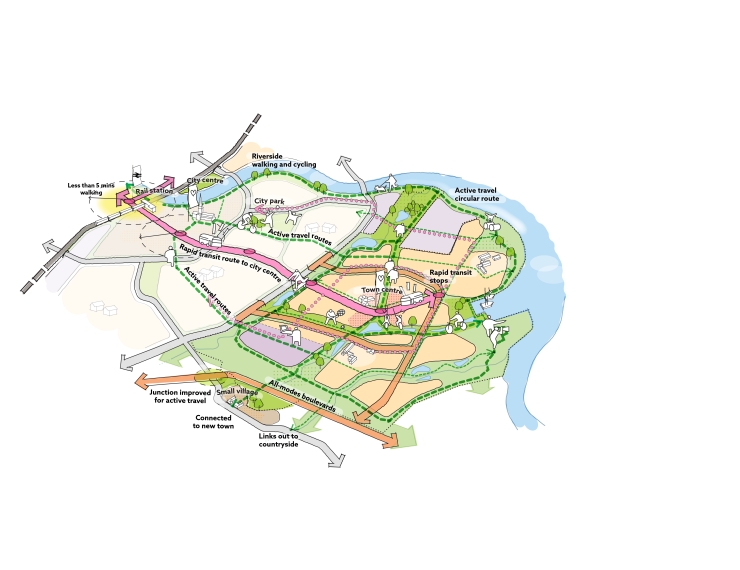


 Huddersfield
 Huddersfield
 London
 Houlton
 Houlton
 Bristol
 Rochester
 Sunderland
 Sunderland
 Chelmsford


